By Busy Fox SEO
27 November 2026
Robbyant, the embodied AI unit inside Ant Group, open-sourced two spatial-intelligence models on 26 November 2026 — streaming 3D reconstruction model `LingBot-Map 2.0` and spatial-memory navigation model `LingBot-Navi` — alongside code, model weights and a dataset of 511 real-world captured scenes.
Autonomous mobile robots routinely suffer from two practical bottlenecks, Robbyant said in its Business Wire announcement: odometry drift accumulates over long journeys without updating a model’s internal memory, and single-task navigation pipelines wipe their maps after each job, forcing robots to re-explore familiar buildings from scratch.
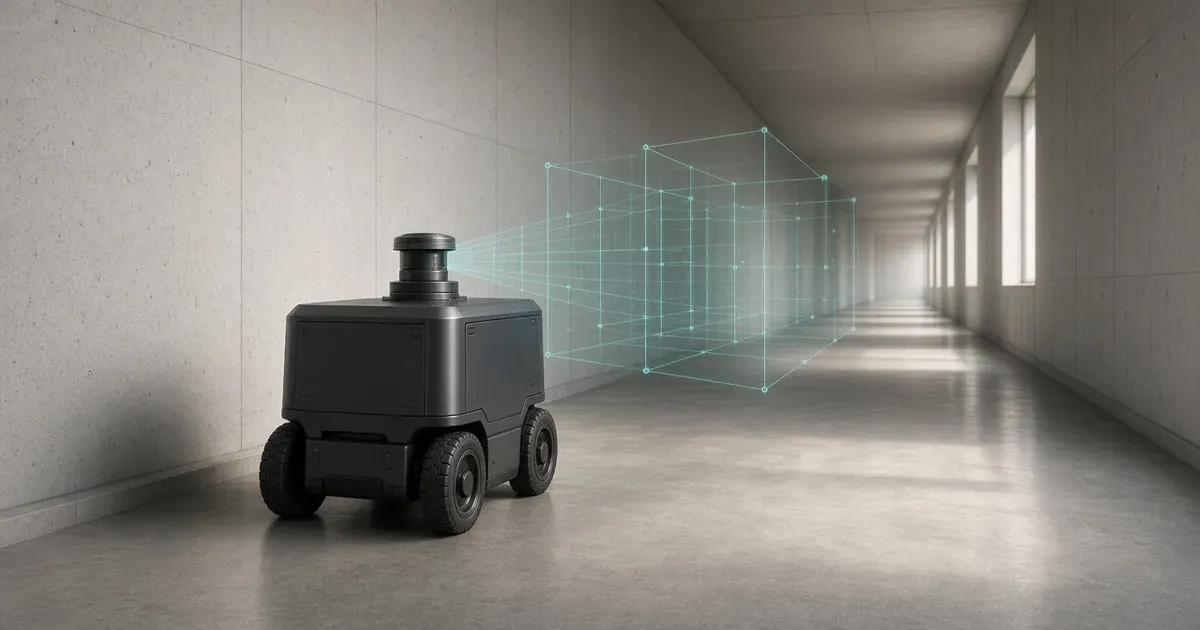
`LingBot-Map 2.0` tackles the first issue through what Robbyant calls Geometric Context Reshaping, updating internal historical memory directly during inference rather than relying on external loop-closure backends. In company-reported benchmarks on a 5.2-kilometre VBR urban trajectory spanning nearly 19,000 frames, Robbyant says version 2.0 cut average trajectory error from 31.12 metres (in April’s v1.0 release) to 4.72 metres — nearly an 85% reduction — while sustaining 27.51 frames per second on a single Nvidia RTX 5090 GPU, and leading Oxford Spires (3.92 m), KITTI (9.42 m), CroCoDL, EuRoC and Oxford dense reconstruction tests.
Built atop that mapper, `LingBot-Navi` keeps persistent spatial memory across missions, pairing 3D geometric coordinates with pretrained vision-language features so a robot can locate itself and plan routes from natural-language prompts on local hardware without re-exploring a site. Across 475 training scenes and 36 held-out real-world reconstructions published on its project page, Robbyant reports end-to-end task success rates of 56.09% on GOAT-Bench and 32.36% on its 36-site evaluation set (rising to 68.60% on a GOAT-Bench simulation-execution subset), noting that swapping `LingBot-Map 1.0` for `2.0` lifted navigation success without retraining `LingBot-Navi`. All benchmark numbers are Robbyant’s own and have not been independently audited here.
Why it matters for Australia
Australian warehouse automation, mining-site inspection, aged-care robotics trials and university mechatronics labs all wrestle with GPS-denied indoor drift and expensive re-mapping. Having weights, GitHub code and 511 reconstructed scenes openly available gives local robotics engineers reproducible baselines they can run locally on consumer or workstation GPUs rather than building SLAM and vision-language navigation from scratch.
Sources
- Robbyant Open-Sources LingBot-Map 2.0 and LingBot-Navi, Enabling Long-Term Spatial Memory and Autonomous Navigation for Robots, Robbyant via Business Wire, 26 November 2026 — https://www.businesswire.com/news/home/20261126690702/en/Robbyant-Open-Sources-LingBot-Map-2.0-and-LingBot-Navi-Enabling-Long-Term-Spatial-Memory-and-Autonomous-Navigation-for-Robots
- LingBot-Navi: Scene-aware Navigation with Spatial Memory, Robbyant, November 2026 — https://technology.robbyant.com/lingbot-navi
- robbyant/lingbot-map-v2 repository, Robbyant, GitHub, November 2026 — https://github.com/robbyant/lingbot-map-v2