By Busy Fox SEO
27 November 2026
SenseTime released open weights on 25 November 2026 for `SenseNova-RoboRSI-27B`, a 27-billion-parameter vision-language model for robotic manipulation published under the permissive Apache License 2.0 alongside a technical blog post on Hugging Face.
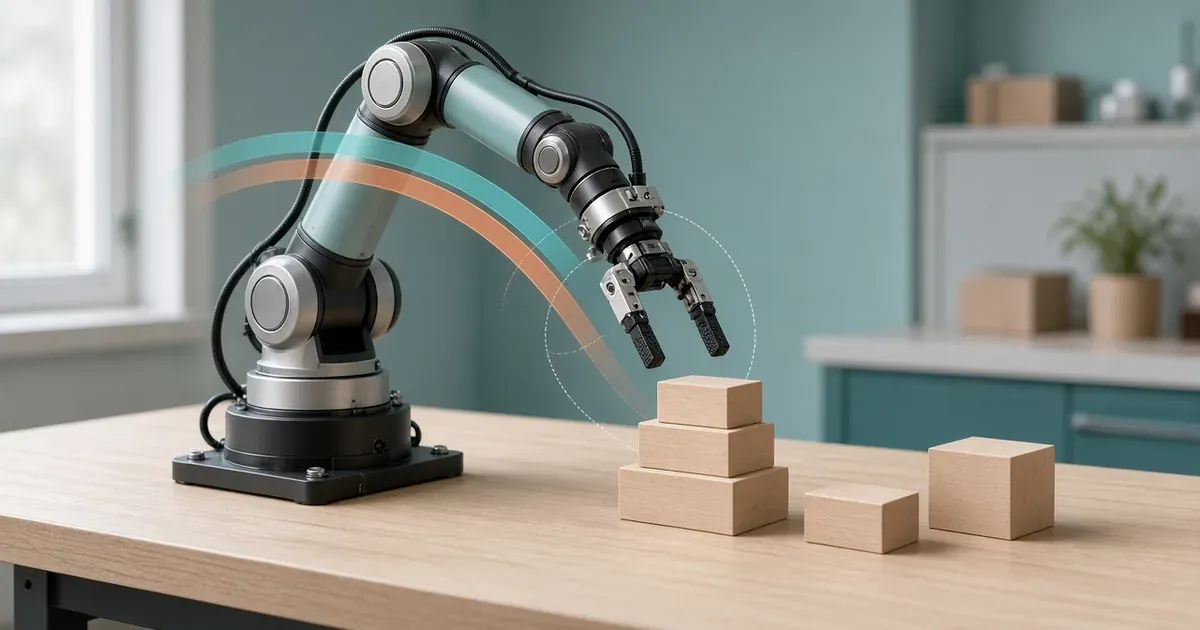
Instead of relying purely on fixed, pre-programmed skills or a single vision-language-action (VLA) policy, SenseTime says the full release alternates dynamically between calling a VLA motion policy (41.9% of environment steps) — suited to smooth approaches and pouring — and generating spatial control programs via “Code as Policy” (58.1% of steps) for precise placement, block stacking or dual-arm alignment. It can also inspect camera feedback to reject flawed trajectories and correct errors mid-task.
SenseTime trained the 27B student through three rounds of joint model-and-tool-harness “recursive self-improvement,” using `GPT-6 Astra` as a teacher model to diagnose failures and expand the execution harness before fine-tuning the 27B checkpoint on selected traces via rejection sampling. In SenseTime’s own reporting, adding single-turn spatial targets extracted from open VLA demonstrations (`VLA2Agent`) reduced median end-effector position error from 119.7 millimetres to 51.6 millimetres and lifted predictions within 5 mm from 4.3% to 15.5%.
On the RoboDojo Agent protocol — where agents receive no task-specific preset procedures at evaluation — SenseTime reports `SenseNova-RoboRSI-27B` scored an average progress score of 34.7 (up from 10.0 for its earlier Preview checkpoint), outscoring the 27.6 figure reported by the RoboDojo team for `GPT-6 Astra` and slightly ahead of `GPT-6.1 Sol` (33.7) in shared-harness tests. Using the exact same simulation-trained weights without real-robot post-training data, SenseTime says the model stacked blocks in 9 of 10 trials on a physical Piper X arm (up from 3 of 10 for Preview) and completed object pick-and-place in 6 of 10 trials on a Piper arm (up from 2 of 10). All evaluation scores and physical trial counts are SenseTime’s own, with a reproduction script promised after leaderboard submission.
Why it matters for Australia
Australian agricultural-robotics startups, university manipulation labs and warehouse integrators frequently struggle with the cost and fragility of gathering thousands of physical robot teleoperation demos. Releasing a commercial-friendly Apache 2.0 27B checkpoint that learns spatial error correction in simulation and switches cleanly between learned motion and geometric code gives local teams an open baseline — though 60% pick-and-place reliability shows real-world deployment still needs cautious guardrails.
Sources
- SenseNova-RoboRSI-27B Full Release Outscores GPT-6-Astra, Pushing the Limits of a 27B Model with Recursive Self-Improvement, SenseTime, 25 November 2026 — https://www.sensetime.com/en/news/sensenova-roborsi-27b-full-release-20261126-1138
- SenseNova-RoboRSI: Integrating VLA and Code as Policy Through Model–Harness Co-Evolution, SenseNova, Hugging Face Blog, 25 November 2026 — https://huggingface.co/blog/sensenova/roborsi
- sensenova/SenseNova-RoboRSI-27B model card, SenseNova, Hugging Face, November 2026 — https://huggingface.co/sensenova/SenseNova-RoboRSI-27B