By Busy Fox SEO
27 November 2026
OpenAI’s `GPT-Live-1.1` — paired with `GPT-6.2 Sol` at medium reasoning effort — sits first among AI systems on Voice Arena’s Jarvis Bench v0.5 (beta), though the leaderboard shows a striking split between sounding natural and reliably completing backend tasks.
Jarvis Bench tests live, multi-turn phone calls placed by real callers rather than scripted audio clips; according to i10X News on 27 November 2026, the beta edition spans 598 calls from 92 callers and 2,442 blind human-rater votes across four everyday scenarios (airline bookings, flight changes, wedding preparation and dietary dinner planning), alongside a tool-log check on airline workflows.
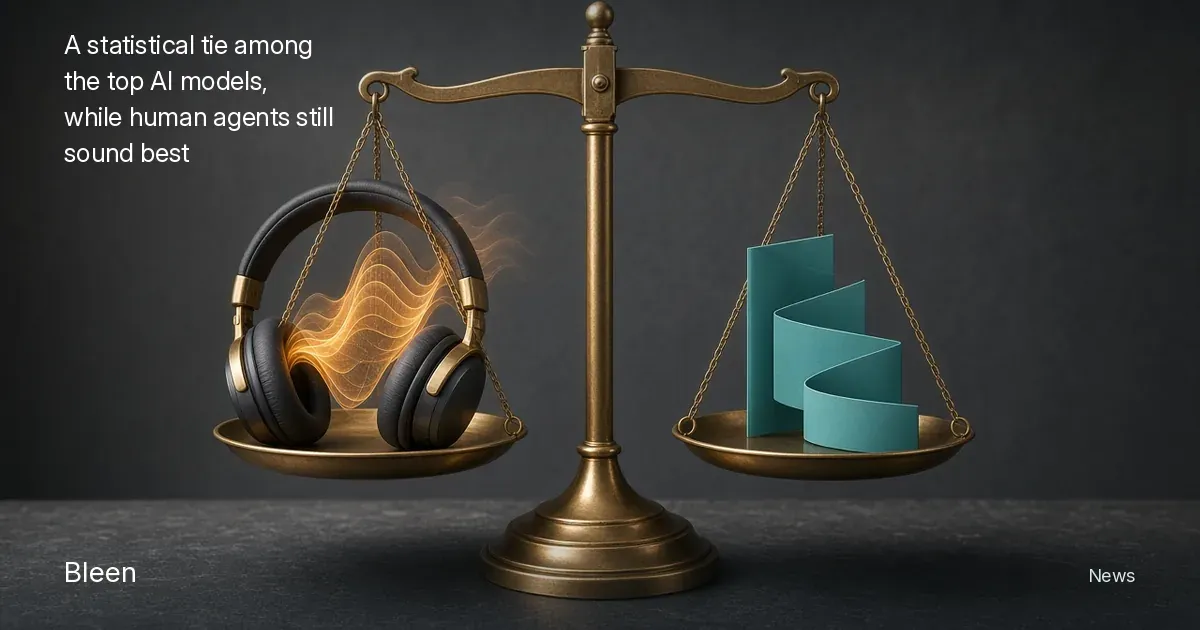
On Voice Arena’s official board, `GPT-Live-1.1` posts a naturalness Elo of 999±24 and a task-effectiveness Elo of 1025±25. Crucially, however, Voice Arena marks `GPT-Live-1.1` as rank `2(2–5)`: because 95% confidence intervals are bootstrapped across callers, its naturalness lead over OpenAI’s `GPT-Realtime-2.1` (968±15), Google DeepMind’s `Gemini 3.8 Live` (966±13) and `Gemini 3.1 Flash Live` (959±17) sits within overlapping confidence intervals — effectively a statistical tie among the top AI models. Meanwhile, a trained human agent still dominates overall listening scores at 1288±41 on naturalness and 1063±29 on task effectiveness (Voice Arena notes listeners may detect a real human voice in direct comparisons).
When Voice Arena checks airline tool logs for whether bookings actually succeeded, the ranking flips completely. `GPT-Live-1.1` completed 100.0% of airline tasks on the first try and 100.0% across all three consecutive tries (`pass³`), ahead of `Gemini 3.8 Live Extended Thinking (High)` (98.0% first try; 93.9% three of three) and `Gemini 3.8 Live` (93.1% first try; 80.4% three of three), whereas the human agent completed 65.0% on the first try and 50.0% across three tries. i10X also noted an unresolved methodological discrepancy on the site — the methodology text says repeat-attempt stats are not computed for real callers, yet `pass²` and `pass³` figures appear on the board — and calculated that OpenAI’s US$0.05-per-minute active voice fee (plus US$0.02/min standby) implies roughly 20 to 40 US cents per 4–8 minute call before backend `GPT-6.2 Sol` token charges.
Why it matters for Australia
Australian airlines, telcos, insurers and banks testing voice bots face a clear engineering trade-off highlighted by Jarvis Bench: current voice models still trail human operators on warmth and vocal naturalness, yet structured API tool execution is already beating rushed human agents on repetitive booking reliability. Local contact centres should measure tool-log completion separately from caller satisfaction — and run Australian-accent and local-slang tests before deploying on live queues.
Sources
- Jarvis Bench — frontier evals for Voice AI (v0.5 Beta), Voice Arena, retrieved 27 November 2026 — https://voicearena.com/jarvis-bench
- GPT-Live-1.1 Tops Jarvis Bench, but Listeners Prefer Humans, i10X News, 27 November 2026 — https://i10x.ai/news/gpt-live-1-1-jarvis-bench-voice-agents-bookings-humans