
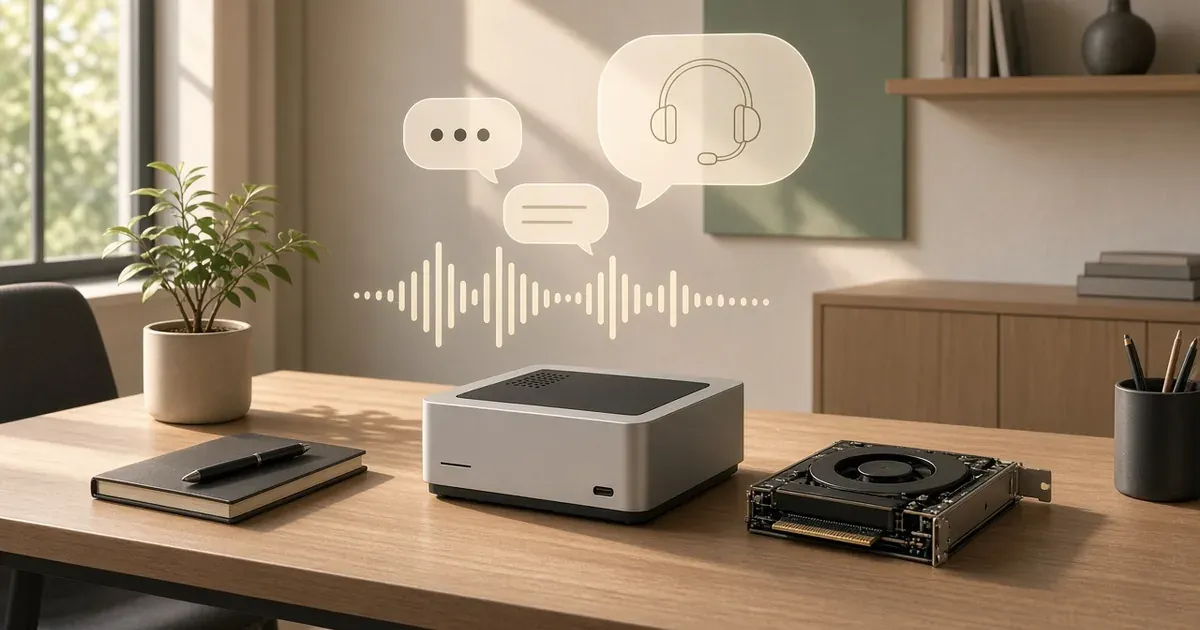
Bengaluru-based Sarvam has released a new open-weight version of its 105-billion-parameter model, aimed at high-volume work such as customer support, voice agents and other tasks that involve tools and long conversations.
The checkpoint, called Sarvam-105B-1711, was announced on the company’s blog on 22 November 2026 and covered by CNBC-TV18 the following day. Sarvam describes it as a Flash-Lite model, trained on the firm’s upgraded Blackwell B200 infrastructure. The weights are available on Hugging Face in two forms: a BF16 build for further training, and a compact NVFP4 build that the company says can run on a single RTX PRO 6000 Blackwell GPU. CNBC-TV18, citing Sarvam, reported that this on-premises option is intended for sensitive work.
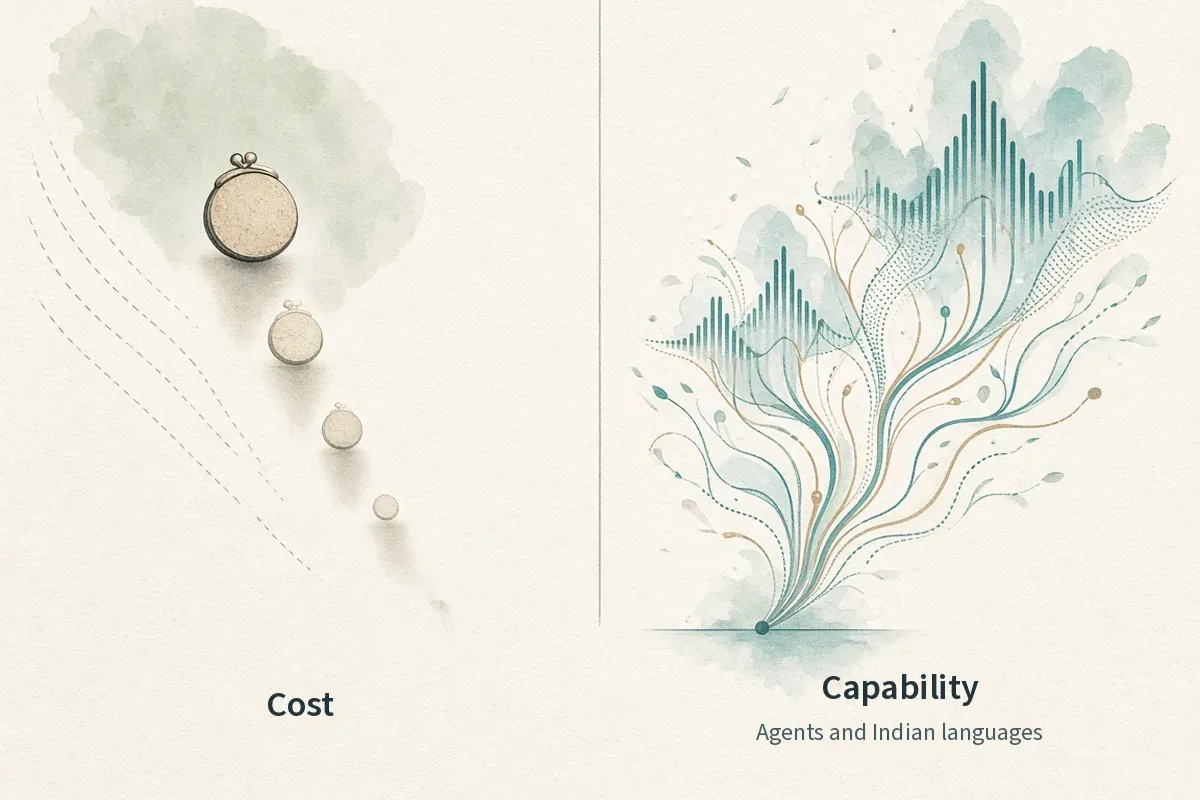
The performance figures published with the release are the company’s own. Sarvam says that, averaged across eight conversational agent benchmarks, the score rose from 42.6 on its February release to 73.9 on the new checkpoint. It reports especially large gains on instruction following (from 32.5 to 82.5 on IFBench), on tool use in customer-service conversations (from 46.2 to 85.5 on Tau2), and on Indian languages (from 30.1 to 79.1 on its own Indic suite). It also says the model completed 69.5% of Tau2 customer-service tasks correctly in all four attempts, which it presents as a consistency edge over the other models it tested.
Sarvam further claims that the new checkpoint matches or closely approaches two better-known Flash-Lite systems on that same eight-benchmark average, at a lower list price. It puts Gemini 3.5 Flash-Lite at 74.0 and Gemma 4 31B at 73.0, and says its own blended inference price has fallen from US$0.44 to US$0.15 per million tokens — about one-fifth of the Google figure and less than a third of the Gemma figure it cites. Those comparisons have not been independently audited in the reports reviewed for this article. They should be read as the lab’s own account.
The company ties the lower cost to changes in how the model is trained and served. It says 8-bit training roughly doubled pretraining throughput on its cluster, that reinforcement-learning steps became faster without a drop in reward, and that a 4-bit serving setup can generate about 6,000 tokens per second on one B200 GPU across 64 concurrent users. In the NVFP4 workstation build, it claims 99 tokens per second per user on a single RTX PRO 6000, a figure it says would let banks, government departments and other organisations run the model on their own premises.
The model’s context window has also been extended. Sarvam says it ran long-context training on 512 GPUs, processing 330 billion tokens in a little over seven days, and lifted the context length to 160,000 tokens. It also describes a voice fine-tune used in a product called Samvaad, which it says scored 68.7 on a public “Samvaad bench”, up from 57.9 for the base checkpoint.
CNBC-TV18 reported API pricing of ₹10 per million input tokens and ₹25 per million output tokens. The same report said Sarvam, founded in 2023, became a unicorn in June 2026. Co-founder Pratyush Kumar said further vision, speech and edge models are planned over the next two weeks, and that the firm is working with partners to bring more training-grade computing capacity into India.
The announcement came during a public debate about Sarvam’s Token Factory inference service and the company’s use of subsidised access to GPUs under India’s government AI mission. Kumar said a 40% subsidy on GPU access, paid to cloud providers rather than to Sarvam directly, helped it train the original 105B model from scratch, and that Token Factory itself runs on GPUs the company bought privately. Those claims are part of the company’s response to criticism; they are noted here as context for the release, not as findings of this article.
What can be said with more confidence is narrower: a new open-weight checkpoint is available, the developer has published a detailed set of in-house scores and price claims, and it is positioning the model for practical, often local, deployment rather than as a general chatbot showcase.
Why it matters for Australia
Australian organisations that want to run open-weight models on their own hardware, keep data on-site, or serve customers in Indian languages may take an interest in a model that is being sold on those terms. Availability, total cost and real-world quality still need to be checked independently, and nothing in the company’s blog amounts to a local certification. For buyers here, the useful test will be whether the claimed gains in tool use, instruction following and on-premises performance show up in their own workloads.