
South Korea’s privacy regulator has opened a public consultation on how organisations may use personal information to develop AI, setting out extra safeguards and a tighter process for higher-risk cases.
The Personal Information Protection Commission (PIPC) said on 23 November 2026 that it is inviting comments until 4 January 2027 on a draft amendment to the Enforcement Decree of the Personal Information Protection Act. The Asia Business Daily reported the announcement in English the same day. An official notice on the government’s korea.kr briefing site confirms that the commission issued a press release on that date about detailed standards for an “AI exception” under the Act, with supporting documents attached.
The draft is meant to fill in a change already made to the Act itself. Under that revision, as described by the Asia Business Daily, personal information that was collected lawfully may be used for AI development after the PIPC has deliberated and reached a decision — but only when development would be difficult using only pseudonymised or anonymised data, and when tests of public or social benefit are met. In other words, the so-called “AI exception” is not a general licence to reuse people’s data. It is a defined pathway that still has to go through the regulator.
If that pathway is used, organisations would have to add safeguards on top of the rules that already apply. The report says they would need to appoint a person in charge, put an internal management plan in place, stop the data being used beyond the scope the PIPC approved, restrict and control who can access it, and destroy the information once it is no longer needed. The commission could also require further measures, depending on the risk of the case.
Some projects would face a prior “risk factor assessment”. That would apply where sensitive information or unique identification information is involved; where the data concern people who already have special protection, such as children; where AI is being developed for continuous observation or tracking of people, or for predicting their behaviour; and where AI would be used to make judgements or decisions that significantly affect people’s rights and interests. Those categories will be familiar to anyone who has watched other countries wrestle with biometric data, children’s data, and automated decisions that can change a person’s opportunities or treatment.
The draft also tries to keep the process from becoming unworkable for similar follow-on cases. Where a new project does not differ in important facts from one the PIPC has already considered — including the purpose of the AI, the scope of the information used, and the processing environment — the deliberation could be streamlined. That shortcut would not apply if a new risk of harm appears, or if an existing risk increases. The commission also plans to set up a separate expert committee to support its decisions.
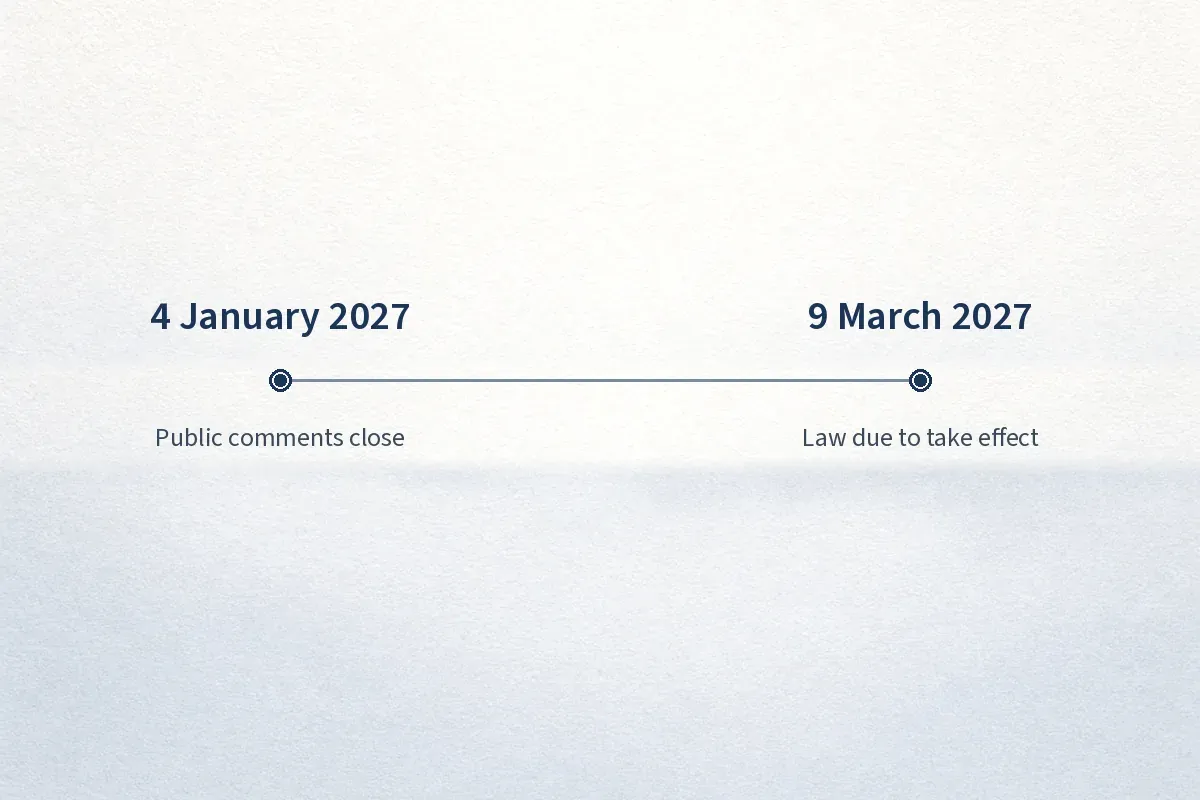
The timetable is tight. The PIPC wants to finish the decree in time for the law’s effective date of 9 March 2027, after review by the Ministry of Government Legislation and the remaining formal steps. Comments are being taken until 4 January 2027. Until the decree is final, the published account is of a draft, not of rules already in force.
For companies, the practical message is that South Korea is trying to say, in advance, when personal data may be reused to train or develop AI, who has to sign off, and which uses are treated as higher risk. The exception is framed as a way to allow AI development in the public interest when de-identified data are not enough — not as a way around privacy law.
Why it matters for Australia
Australian privacy law still governs how personal information is handled here, and this consultation does not change that. The direct effect is on organisations that use personal data collected in South Korea, serve Korean customers, or develop AI in or with Korean partners. Those organisations may need to follow the new process once it takes effect, including the extra safeguards and, in higher-risk cases, a prior assessment. For Australian firms watching how other countries write “AI exceptions” into privacy law, the draft is also a useful reference: reuse is being tied to regulator approval, a public-benefit test, and a duty to destroy the data when the approved use ends.